Blogs · White Mountains
Snow load and your White Mountains roof: 5 warning signs
Ice at the eaves. Fasteners backing out. A ridge that no longer runs straight. Interior stains that show up in February, not July. Ridge caps that lifted in the last wind. Those five are what we look for on Show Low, Pinetop-Lakeside, and Heber-Overgaard roofs before January makes them expensive.
By Evan Baker, owner · August 31, 2026 · 9 minute read
What does snow load actually mean at 6,400 to 7,000 feet?
It means the roof has to carry accumulated snow for weeks, then survive the melt-and-refreeze cycle at the eaves, and then take wind that lifts ridge caps. A Phoenix spec does none of that. Show Low sits at 6,400 feet, Heber-Overgaard at 6,600, Pinetop-Lakeside at 7,000. Those are mountain roofs.
Snow load is weight. Wet snow on a low-pitch cabin is a different number than dry powder on a steep metal gable, but both sit there. Freeze-thaw is motion: water into a crack at 2 p.m., ice in the same crack at 2 a.m., a slightly bigger crack by March. Ice dams are plumbing in reverse: a warm attic melts the upper roof, water runs down, and it refreezes at the cold eave. The dam backs water up under the roofing and onto the insulation.
Most homes in these towns were built in the 1980s through the 2000s. A lot of those first roofs were installed without ice-and-water shield at the eaves and valleys, without snow-rated fastener patterns, and without ventilation that keeps the deck cold. The shingles can still look "pretty good" from the driveway in October. January is when the shortcuts show.
Warning sign 1: Ice at the eaves. What am I looking at?
A thick ice line along the drip edge, icicles that keep growing after a warm afternoon, or a frozen gutter that will not drain, is an ice dam starting or already built. That is meltwater that should have left the roof and did not.
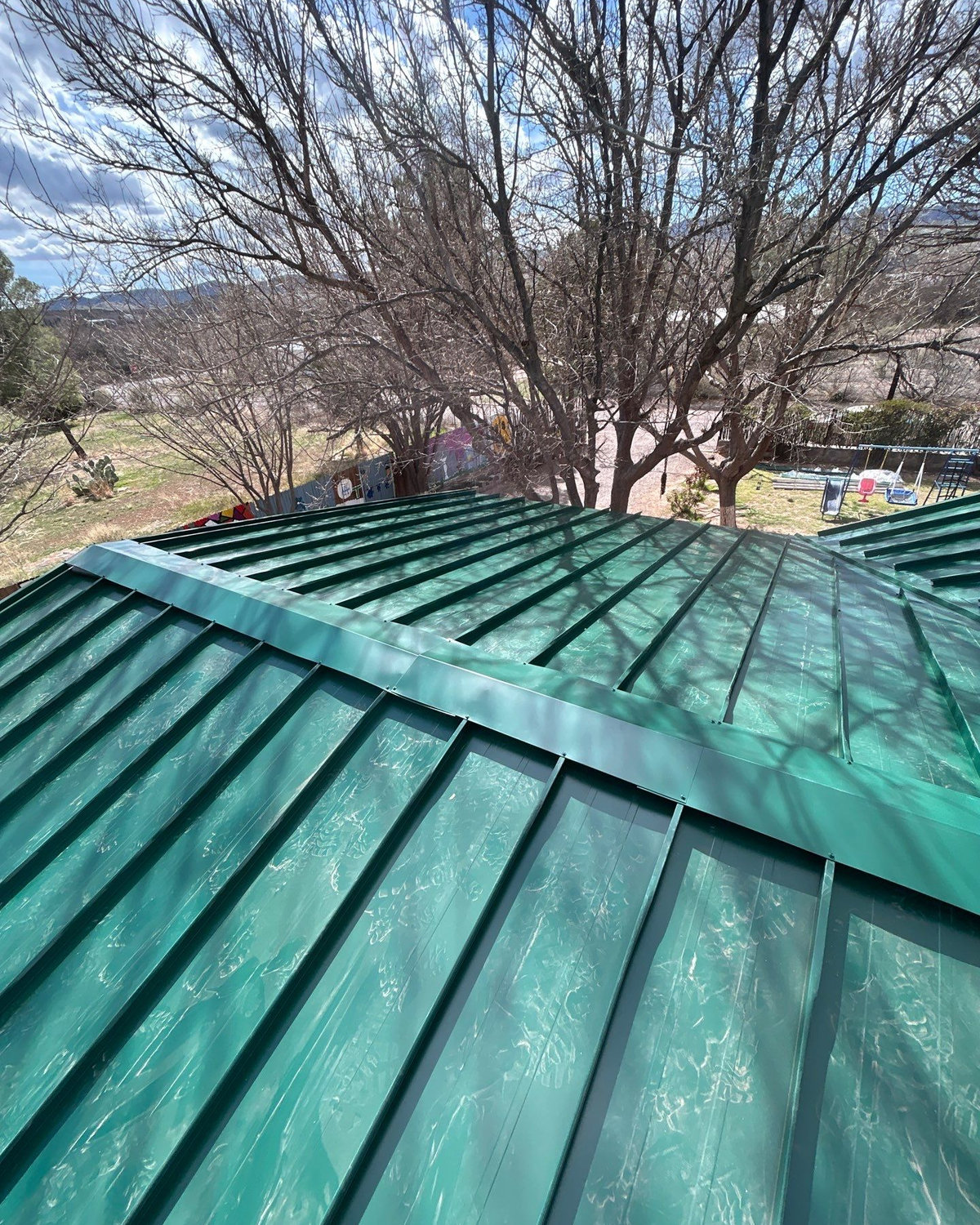
Prevention is a cold roof: a sealed ceiling, enough insulation, balanced ridge and intake ventilation, and ice-and-water membrane as the last line of defense at eaves and valleys. Metal helps because it sheds snow before a dam can form, which is one reason we recommend it on cabins under the pines. Heat cable in a gutter treats the symptom. It does not fix a warm attic.
Look from the ground after the next melt day. If the upper roof is bare and the eave is a solid white bar, call. That pattern is the textbook dam. We see it on 1990s roofs in Torreon and Bison Ridge the same way we see it on cabins off the lakes in Pinetop.
Warning sign 2: Why are fasteners backing out?
Snow load and wind work a fastener like a loose tooth. On exposed-fastener metal, you will see screw heads sitting high, missing gaskets, or rust rings. On shingle, you will see nails popping along a course or a ridge. Both are mechanical failures, not "just weather."
A Show Low roof can swing from single-digit nights to a 140°F panel surface in the same year. Concealed clips on standing seam are built for that expansion. Screws through the rib of a panel are not; they work loose and the panel leaks at year three. We tear those off more than any other metal mistake.
From the ground, binoculars or a phone zoom on a south-facing slope will show proud nail heads or a line of screw shadows that do not sit flush. After a wind event, walk the yard for caps and tabs before you assume the roof "looked fine last fall."
Warning sign 3: What does a sagging ridge line mean?
A ridge that dips, waves, or looks tired in the middle is the roof telling you the structure or the deck is moving. Snow load finds the weak truss, the undersized rafter, or the decking that has been wet too many winters. This is not a caulk job.
Stand at the end of the driveway and sight the ridge against the trees or the sky. A straight line is what you want. A soft belly in the middle, or a kink at a valley, is a reason to get a roofer and, if it is structural, the right people on the framing. We photograph it, we do not guess from the street, and we do not put new shingles over a ridge that is already losing.
Older cabins under mature pines in Pinetop-Lakeside and the 1980s–1990s stock in Heber and Overgaard are where we see this most. Shade keeps the deck wet. Needles keep the valleys wet. Snow adds the weight. Three climates on one roof, all winter.
Warning sign 4: Why do the stains show up in February, not during the storm?
Because ice-dam water enters at the eave and runs inside the wall or along the ceiling until a warm spell lets it drip. The stain on an exterior-wall ceiling in February is last month's snow, not this morning's cloud.
Most 1990s roofs in Payson, Show Low, and Heber-Overgaard were built without ice-and-water shield, so there is no membrane under that first course when the dam backs up. You cannot see that from the kitchen. You can see the brown ring, the bubbling paint, and the musty closet on the north wall.
If you only use the cabin on weekends, look at the ceilings when you open the house. Photograph them. A seasonal owner who waits until April is looking at a winter of wet insulation. We inspect with you gone, send the photos the same day, and tell you whether it is a flashing repair or a roof that is done.
Warning sign 5: Why do ridge caps lift after a White Mountains wind event?
Wind uplift at ridges and rakes is a mountain failure mode. Caps that were hand-sealed poorly, or nailed short of six nails per shingle, let go. Once a cap lifts, the next storm drives water straight into the ridge vent and the deck.
Walk the yard after wind. Caps, tabs, and pine limbs tell the story. From the ground, a ridge that looks saw-toothed, with gaps on the downwind side, is enough to call. Do not get on the roof to "press them back down." A loose cap on a steep Pinetop pitch is how a weekend trip ends at the hospital.
We spec six nails per shingle, hand-sealed tabs in cold installs, and snow-rated fastening and clip spacing on metal. Wind and snow are the same conversation at 7,000 feet. A roof that only planned for one of them was specified for a different town.
What should I do before January?
Get a free inspection while the deck is dry and the roads are open. Late summer and fall are when we can still see fasteners, valleys, and attic moisture without digging out a path. January we can still work in dry windows. We would rather tell you the roof is fine in September than tarp it in a snow week.
Clear what you can reach from the ground: needles in gutters, debris at the eave, anything that dams a downspout. Do not get on the roof to blow the valleys. Under ponderosa in Payson, Pine, Pinetop, and Heber-Overgaard, needle mats are a valley problem we check on every visit; metal open valleys and guards are how we keep them from sitting wet all winter.
Then decide with numbers. If the roof has years left, we say so and leave. If it needs ice-and-water, ventilation, or a repair, you get a fixed written scope. If it is done, we show shingle and metal side by side, including snow-rated metal detailing, and you pick. Schedule the inspection or call (928) 951-2331. White Mountains visits are routed together from the Thatcher office, about two and a half to three hours up the hill.
Questions from the hill
Snow-load FAQs
Can you replace a roof in winter in Show Low or Pinetop?
Does a metal roof handle White Mountains snow better than shingle?
I am a seasonal owner. Can you inspect while I am not there?
Do I need ice-and-water shield if my shingles still look fine?
How much does a new roof cost in the White Mountains?
Do you really drive up from Thatcher for a repair?
Look at the roof before January does.
Free White Mountains inspection, photo report, written scope. We call back within 1 business hour.