The Arizona roofing guide
Metal Roofing in Arizona: Heat, Snow, and What Actually Lasts
Our territory runs from 2,300 feet at Roosevelt Lake to 7,000 feet in Pinetop. No single roof is right for all of it. This is what we have learned tearing off roofs across three climates, written for the homeowner deciding between shingle and metal.
By Evan Baker, owner · Updated September 2026 · 12 minute read
In this guide
- Why Arizona is three roofing climates, not one
- How shingle roofs fail at each elevation
- Why metal works here, and where it doesn't
- Standing seam or exposed fastener?
- What metal costs in Arizona
- Snow load, ice dams, and the White Mountains spec
- Heat, color, and the Gila Valley spec
- Wildfire and Firewise details above the Rim
- The five metal roof mistakes we tear off most
- How to decide for your house
Why is Arizona three roofing climates, not one?
Our service area spans 4,700 feet of elevation. The Gila Valley bakes at 110°F surface temperatures with monsoon downpours. Rim Country adds pine debris, freeze-thaw, and wildfire. The White Mountains carry real snow load and 60 mph wind. A roof spec that is correct in Safford fails in Show Low, and vice versa.
A roof in the East Valley and a roof in the White Mountains need different details. We build the scope around the conditions at your property. Safford and Thatcher at 2,900 feet see summer roof-surface temperatures above 150°F and monsoon cells that drop an inch of rain in twenty minutes. Payson at 5,000 feet sits under ponderosa pine, freezes most winter nights, and is Firewise territory. Show Low, Pinetop-Lakeside, and Heber-Overgaard at 6,400 to 7,000 feet carry snow for weeks and take wind that lifts ridge caps.
Every recommendation in this guide is tagged by elevation for that reason. When a roofer quotes you without asking where the house is, that is the tell.
How do shingle roofs fail at each elevation?
In the valley, asphalt shingles cook: granule loss, thermal cracking, and sealant failure after 15 to 20 years. Under the Rim, needles dam the valleys and ice backs under the eaves. In the mountains, wind lifts tabs and snow load stresses fasteners. Shingle is a fine roof in all three places if it is installed for the place. It just lasts a different number of years in each.
Gila Valley: the failure is heat. Most 1980s and 1990s shingle roofs in Safford and Thatcher are past design life now, showing as bald spots on south slopes, cupped edges, and brittle tabs that crack when a repair crew kneels on them. Architectural shingles with proper ridge and intake ventilation get 20 to 25 years here; three-tab gets less.
Rim Country: the failure is water that should have left and didn't. Needle mats in closed-cut valleys hold moisture against the shingle. Meltwater refreezes at the cold eave and backs under the first courses; most 1990s Payson roofs were built without ice-and-water shield, so the stain shows on the ceiling below an exterior wall in February.
White Mountains: the failure is mechanical. Wind uplift at ridges and rakes, snow load and slide stressing fasteners, and freeze-thaw at every penetration. Shingle roofs here need six nails per shingle, hand-sealed tabs in cold installs, and ice-and-water across eaves and valleys.
Why does metal work so well here, and where doesn't it?
Metal reflects valley heat, sheds Rim Country needles and snow, resists embers, and carries high wind and impact ratings. Installed correctly it lasts 40 to 60 years. Where it doesn't make sense: very cut-up roofs where trim costs balloon, tight HOA color palettes, and homeowners who will sell in under ten years and won't recoup the premium.
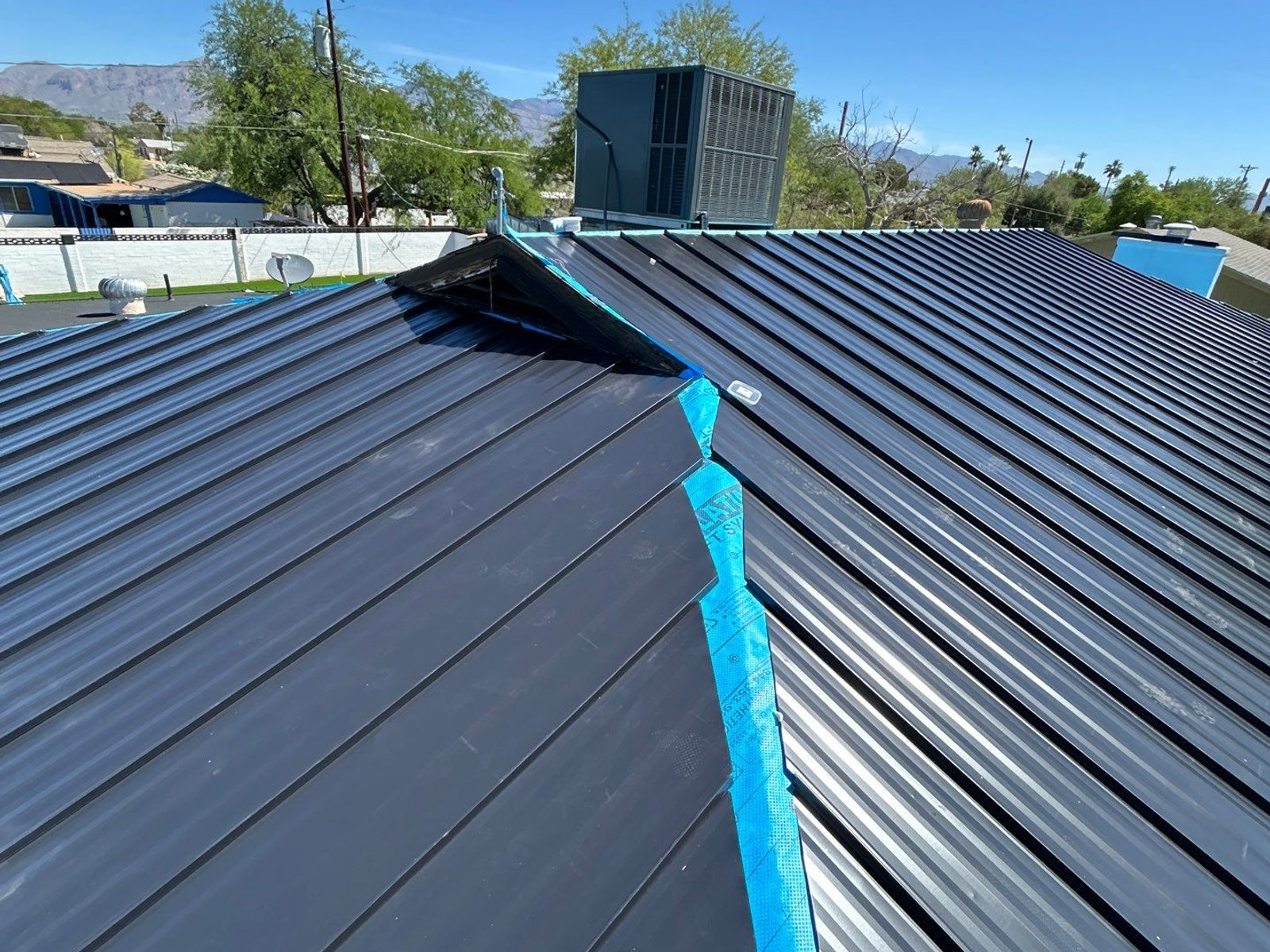
Metal is the roof we install most above 5,000 feet and recommend most often across the territory. A standing-seam panel with a cool-rated finish drops attic temperatures in Safford, slides snow in Pinetop, and shrugs off the ponderosa debris that kills shingle valleys in Payson. It carries Class 4 impact ratings for the Willcox hail belt and Class A fire ratings for Firewise country.
Its weaknesses are honest ones. Metal costs 1.5 to 2.5 times shingle up front. Complex roofs with many hips, valleys, and dormers drive trim and labor costs up fast. Some HOAs restrict profile and color. And a metal roof installed by a crew that fastens through the rib, skips closures, or uses the wrong sealant will leak at year three at every screw; the material is only as good as the installer.
Standing seam or exposed fastener: which one for my house?
Standing seam hides the fasteners under interlocking panels, sheds snow cleanly, and is the longer-lived architectural choice for homes. Exposed-fastener panels cost roughly 30 to 40 percent less, install faster, and are the right call for shops, barns, and budget-conscious homes if you accept gasket maintenance around year 15 to 20.
Standing seam: concealed clips let the panel expand and contract without stressing a fastener, which matters when a Show Low roof swings from 10°F to 140°F surface temperature in a year. No exposed screws means no gaskets to age out. It is what we put on homes and cabins where the roof is visible and where snow slides need a clean path.
Exposed fastener: gasketed screws through the flat of the panel, into the deck. Faster, cheaper, and fine for outbuildings and for homes where budget rules. The gaskets are the maintenance item: plan on a fastener check and partial replacement around year 15. Never let a crew fasten through the rib; the screw works loose and the panel leaks.
What does a metal roof cost in Arizona?
For a typical 1,800 sq ft home, a metal roof from Big Buckle runs $23,600 to $43,100, against $12,200 to $16,900 for architectural shingle and $13,500 to $21,600 for tile. On 15-year financing at 8.99% APR that is roughly $239 – $437 a month for metal. Standing seam, steep pitch, complex trim, and drive time push toward the top.
What moves the number: panel profile (standing seam costs more than exposed fastener), gauge (24 gauge outlasts 26 and 29), finish (cool-rated PVDF paints cost more and last longer than polyester), roof complexity, tear-off layers, decking replacement, and elevation detailing like ice-and-water shield and snow-rated clip spacing.
See example prices for 1,500 to 5,000 sq ft homes on our metal roofing page, or use the calculator there for your exact square footage. It is a range estimate, not a quote; the fixed number comes after a free inspection.
What does snow load and ice damming mean for a White Mountains roof?
Show Low, Pinetop-Lakeside, and Heber-Overgaard roofs must carry accumulated snow and survive the melt-refreeze cycle at the eaves. That means snow-rated fastening, ice-and-water shield at eaves and valleys, ventilation that keeps the deck cold, and snow guards above entries so slides don't land on your porch.
Ice dams form when a warm attic melts snow on the upper roof, the water runs down, and it refreezes at the cold eave. The dam backs water up under the roofing. Prevention is a cold roof: sealed ceiling, adequate insulation, balanced ridge and intake ventilation, and ice-and-water membrane as the last line of defense. Metal sheds snow before it can dam, which is one of its biggest advantages here.
Snow slides are the other issue. A standing-seam roof will shed a foot of snow in one event, and if that lands on a walkway, a gas meter, or your truck, you have a problem. We place snow guards or rails above entries and equipment. Ask your neighbor with the new metal roof about their first winter; they will have a story.
What does heat mean for a Gila Valley roof?
Safford, Thatcher, Pima, and Willcox roofs run above 150°F on summer afternoons. Dark shingle cooks; light-colored, cool-rated metal reflects a large share of solar heat and lowers attic temperatures, which shows up on the power bill. Ventilation matters as much as color.
Cool-rated finishes in tan, gray, light green, and even some blues reflect far more heat than a dark shingle. Pair that with a ridge vent and real intake at the eaves and a valley attic can drop by 20 to 30 degrees in July. Black metal looks sharp and we install plenty of it, but in the valley we tell you the tradeoff first.
Flat and low-slope block homes across the valley are a separate conversation: coatings and drainage, covered in our roof coatings guide.
What do Firewise and wildfire codes require above the Rim?
Payson, Pine, Strawberry, Show Low, and Heber-Overgaard are wildfire-exposed communities. Class A roofing, ember-resistant vent screening, no debris traps at the eave, and clean roof-to-wall transitions are the standard we install by default. Metal roofs are inherently Class A and shed the needles that become fuel.
The 1990 Dude Fire and the 2002 Rodeo-Chediski Fire are local memory, and insurers increasingly price the risk. A Class A roof with screened vents and cleared gutters is both a code question and an insurability question in a few years. We build to it now so you don't re-roof for it later.
What are the five metal roof mistakes you tear off most?
Fasteners through the rib instead of the flat. Missing closures at ridge and eave. Panels laid over old shingles that hid rotten decking. No ice-and-water shield above the Rim. Mismatched metals (galvanized fasteners in aluminum trim) that corrode each other. Every one is an installer mistake, not a material one.
The pattern in all five is a crew that knew how to install shingle and treated metal the same way. Metal is a system with its own rules for expansion, sealing, and drainage. When you interview a metal roofer, ask to see a job they did five winters ago. Ours are on the Brand Map.
How should I decide for my house?
Ask three questions. How long will you own the home? Under ten years, shingle usually wins on cost. What is over the roof? Pines and snow favor metal. What is the roof shape? Simple gables favor metal; cut-up roofs narrow the gap toward shingle. Then get both numbers in writing from a roofer who has stood on the roof.
That is what our free inspection is for. We inspect, photograph, and give you shingle and metal side by side with fixed prices. No pressure, no expiration date. Schedule it here or call (928) 951-2331.
Start with the roof in front of you.
Free in-person inspection. Photos. A written scope within two business days. No pressure, stated and meant.